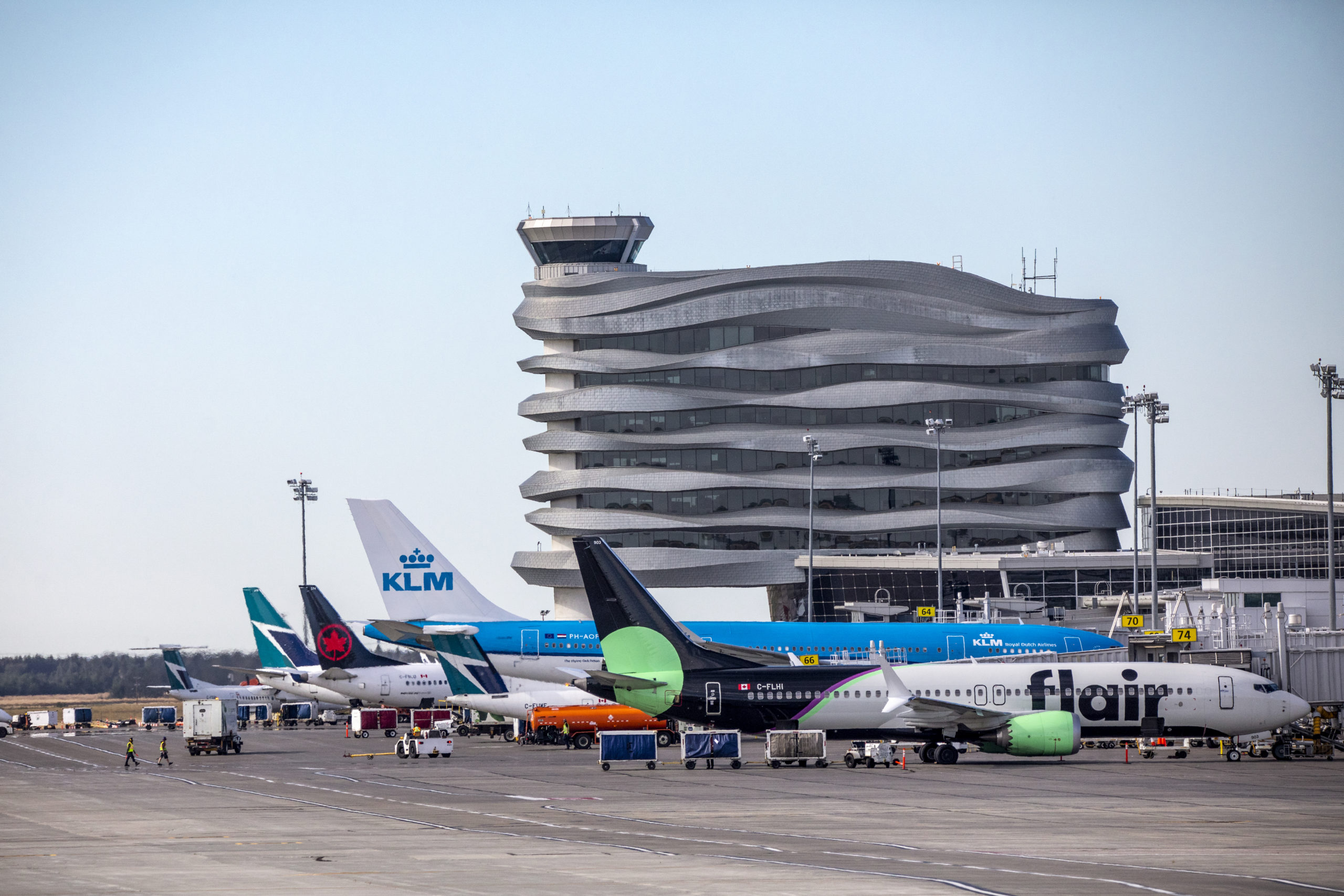
The Story of Edmonton International
Airport
Edmonton International Airport is the newest and largest of four
airports operated by the Edmonton Regional Airports Authority (or
Edmonton Airports), a community-based, not-for-profit authority
established in 1990. Edmonton Airports also operates the
Edmonton City Centre Airport, Cooking
Lake Airport and Villeneuve Airport.
Originally opened in 1927 to house a flying school, the airfield
just northwest of downtown Edmonton became the city's primary
scheduled airport and an important military airfield during the
Second World War. However, it didn't take long for aviation and the
city of Edmonton to outgrow the airport. With a city all around,
there was no room to extend its less than 6,000-foot-long
propeller-age runways.
By 1955, it was obvious that the downtown airport was inadequate
for the coming jet airliners, which would need two-mile runways and
spacious terminals to handle 100-plus passengers per flight. A site
for Edmonton International Airport was selected near Leduc and
Transport Canada purchased 7,600 acres of land for a total cost of
$1,469,657. By an unwritten "gentleman's agreement," the original
owners were allowed to lease back and continue to farm the land
until it was needed for the airport. Edmonton International Airport
remains Canada's largest airport in area - with more than half of
its land still under cultivation.
Turning farmland into runways had some interesting complications.
Weeds overtook the construction area and polluted the surrounding
farmland. A stubborn clan of beavers outwitted many human attempts
to prevent them from flooding the site. Airport security in those
days meant keeping livestock off the runways.
On November 15, 1960, Edmonton International Airport opened for
passenger service with what is now the L-3 Communications Spar
Aviation hangar serving as a temporary terminal. Three years later,
the 370,000-sq.-ft. steel and glass building that is now the core
of EIA's north terminal opened. It cost $10 million and was ready a
year ahead of schedule.
Designed for a 20-year horizon, the terminal was underutilized for
its first years of operation, but this was not to last. In 1962,
the old airport processed 394,000 passengers. By 1973 the number
nearly doubled to 755,000 and by 1974 it exceeded 1.1 million
passengers. In 1980, passengers numbered over 2 million and the
summer of 1983 saw the completion of a 50,000-sq. ft.
addition.
During the 1970s and 1980s, Edmonton International Airport handled
a second generation of wide-body jets such as Boeing 747s and
Lockheed 1011s that carried up to 400 passengers nonstop to Europe.
At the same time, the Edmonton Municipal Airport developed a
growing niche as a hub for short-haul flights, including Pacific
Western Airlines' frequent Boeing 737 AirBus service to
Calgary.
Although more convenient for some business travellers, the
two-airport system had many disadvantages. Connecting passengers
often had to travel between two airports. Passenger volumes at EIA
actually declined between 1983 and 1995. There were fewer nonstop
flights from Edmonton International and more connections required
through Calgary or Vancouver. Passenger growth at "the Muni"
created more aircraft noise near the downtown airport.
In October 1995, 77 per cent of Edmontonians voted to consolidate
commercial flights at the International Airport. The Municipal
Airport would continue to serve private and general aviation under
a new name, the Edmonton City Centre Airport.
Although a success, consolidation put new pressures on Edmonton
International Airport. The terminal had been designed to
accommodate 2.5 million passengers per year, but by 1999, 3.8
million passengers were using EIA. In the late 1990s and early
2000s, Edmonton International Airport underwent a major
construction program costing $450 million. A new south terminal was
built to house Air Canada and international carriers, while rapidly
growing WestJet became the principal tenant of the north terminal.
A Central Hall was developed to house passenger screening and
retail services for both terminals and to accommodate commuter
carriers. A new cargo apron was built to handle growing volumes of
shipments by air.
By 2007, EIA was handling over 6 million passengers per year,
flying to 53 non-stop destinations in Canada, the United States,
Mexico, the Caribbean and Europe. To accommodate 9 million
passengers by 2012, Edmonton International Airport plans to spend
another $1 billion on an airport expansion project that will add
gates, build a new passenger concourse and expand parking.